


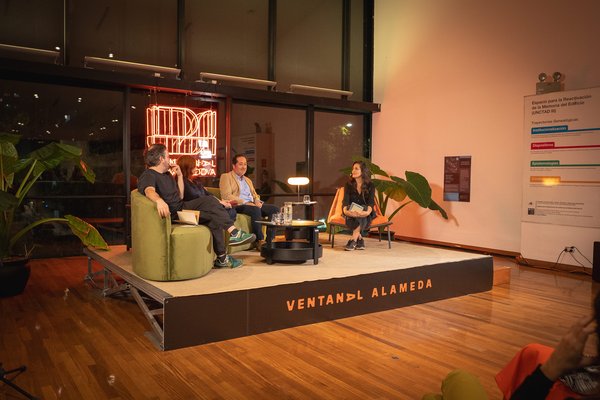
With the city as a backdrop from BiblioGAM, a new scenario is born for the boiling of ideas and contemporary thought. The fourth session of Ventanal Alameda will address artificial intelligence and its consequences on human creativity.
Mi 27 May: Human identity, creativity and AI
Host: Viviana Encina / Panelists: Isidora Cabezón, Abel Wajnerman, Evelyn Cordero.
The emergence of Artificial Intelligence forces us to redefine the limits of humanity. Is creativity an exclusive trait of our species or a replicable process? Ethics, copyright and the future of art in a world where robots have begun to paint and write.

Viviana Encina
Journalist
Journalist and graduate in Philosophy and Humanities from the Alberto Hurtado University, with more than twenty years of experience in the media, mainly in television and radio.
In recent years he has deepened his specialization in culture and entertainment. She is a host and columnist on content linked to cinema, literature, music and contemporary cultural phenomena.
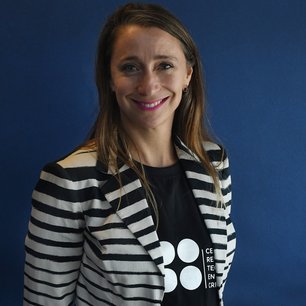
Isidora Cabezón Papic
CRTIC Executive Director
Journalist and Master in Social Communication from the Pontifical Catholic University of Chile, with an Academic Certificate in Dramaturgy from the Theater School of the same university. During her career she has been linked to creation, cultural management and communications, in positions in the public and private spheres.
She has worked on television as a scriptwriter and audiovisual director; She was editor of the magazine specialized in visual arts “Arte Al Límite”; founder and director of the Easter Island Film Festival “Rapa Nui Film Fest”; Head of Regional Coordination of the National Council of Culture and the Arts of Chile (current Ministry of Cultures, Arts and Heritage); Coordinator of Artistic Programming at Fundación CorpArtes and recently was Coordinator of Creative Economy at CORFO.
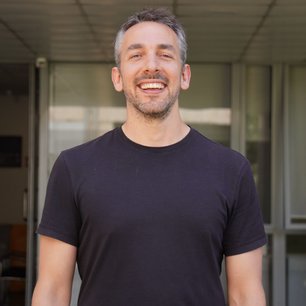
Abel Wajnerman Paz
Associate researcher at CENIA
Professor at the Institute of Applied Ethics of the Pontifical Catholic University of Chile. He obtained his Doctorate in Philosophy from the University of Buenos Aires (2014). His main areas of specialization are the Philosophy of Neuroscience and Neuroethics. His research has focused on understanding the relationship between cognitive phenomena and neural mechanisms, and how these can deepen our understanding of key ethical concepts such as autonomy and identity. His recent book "Outdoor Thought" invites the entire public to reflect on these issues.
He is currently focused on the integration of neuroethics with the ethics of Artificial Intelligence regarding the impact of AI on mental health, education and human development.

Evelyn Cordero Roldán
Doctor in Neurosciences and educator
Doctor in Neurosciences and educator, specialized in the study of creativity, learning and the relationship between science, education and society. She is executive director of Fundación Arrebol and has developed a career aimed at understanding how creativity emerges from cognitive and neurobiological processes, integrating tools such as EEG to study the neural correlates of divergent thinking.
His work seeks to build bridges between scientific research and the contemporary challenges of education, culture and the dissemination of knowledge, promoting a rigorous, critical and evidence-based view. She has actively participated in public science communication initiatives and has been recognized for her contribution to the educational and scientific field, including distinctions such as 100 Women Leaders of Chile, Mujer Impacta and her participation in spaces such as Congreso Futuro, where she has addressed creativity, learning and critical thinking from a neuroscientific and social perspective.
Upcoming dates:
May 27, 2026
Wed—7 p.m. to 9 p.m.
BiblioGAM (Edificio A, piso 3)
Free, upon registration.
Limited spaces.
Produces: Gabriela Mistral Cultural Center, GAM
Presented by: CENIA and CRTIC
Collaborators: Biophilia, UNIACC, Emisor Podcasting, Viña Concha y Toro.