


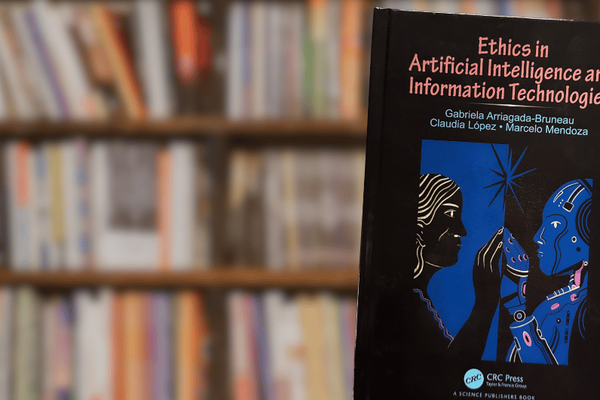
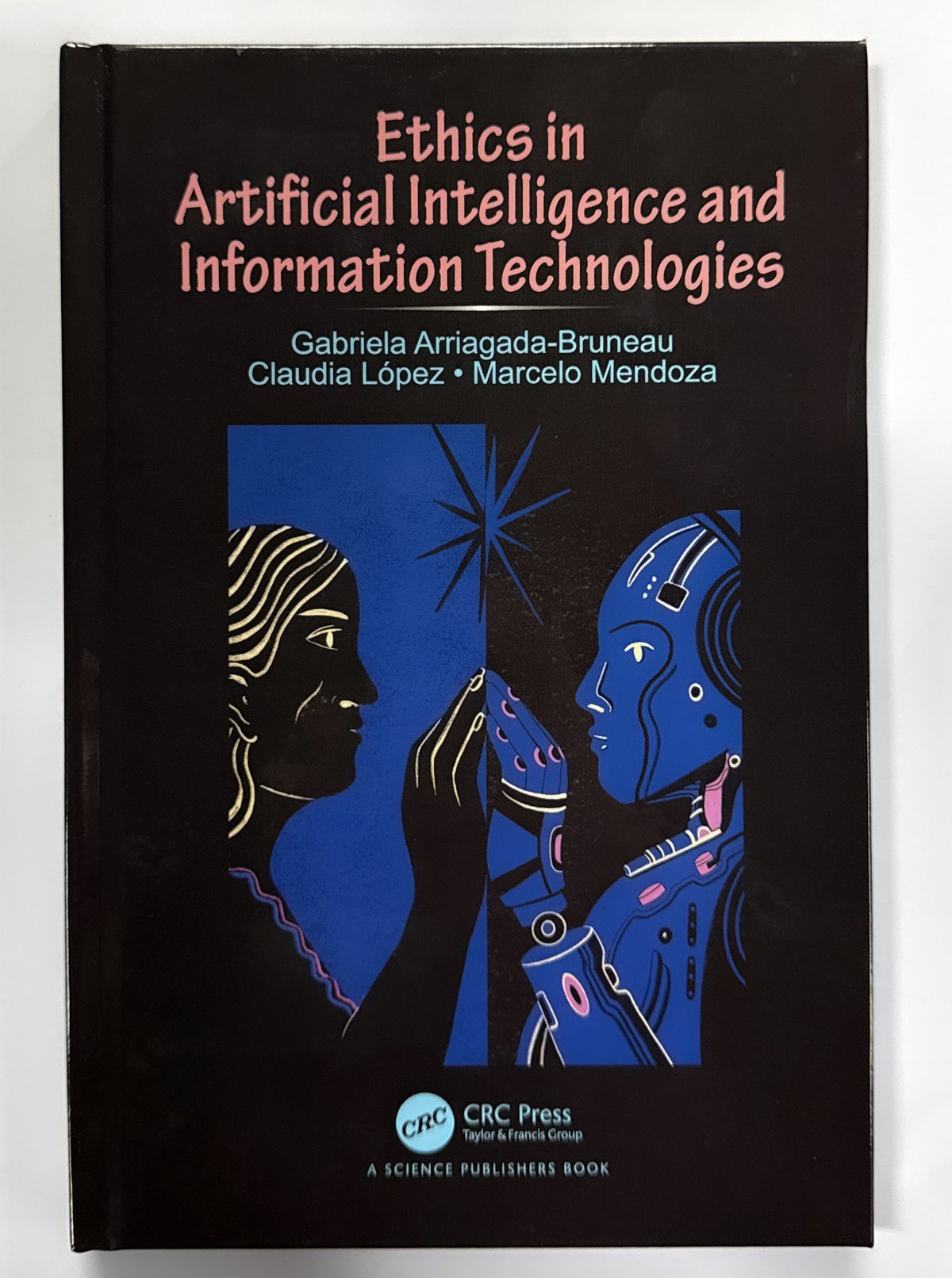
In an era defined by digital transformation, the National Center for Artificial Intelligence (CENIA) highlights the publication of the book “Ethics in Artificial Intelligence and Information Technologies”. This work, crucial to addressing the ethical and social challenges of AI, is the result of the joint work of three CENIA researchers: Gabriela Arriagada-Bruneau, Claudia López and Marcelo Mendoza.
This book is a tool to understand the impact of Artificial Intelligence (AI) on daily life. With a socio-technical approach, the authors break down complex concepts so that they are accessible to the general public, as well as students, researchers and professionals interested in the subject. The text starts from the basis of ethics in AI, presenting a framework to integrate ethical principles in each stage of a technological development project.
“The growth of AI in our lives makes it essential to analyze its social and ethical impact,” comments Claudia López, co-author and principal researcher at CENIA. “This book seeks to put people at the center of the conversation about AI to ensure that its development benefits all of society.”
“Our goal is that the discourse of responsible and ethical AI is not something anecdotal or desirable, it is something inherent to AI itself,” says Gabriela Arriagada, also co-author of the text. “That is why we wanted to bring together our experiences and interdisciplinary knowledge to generate a reference book that allows us to delve deeper into ethical, technical, and sociotechnical aspects of the development of AI and information technologies.”
What distinguishes this work is the interdisciplinary commitment that its authors made, articulating the view of philosophy and ethics as a general framework to operationalize decision-making and the social impacts of AI. To do this, they address fundamental issues such as justice, accountability and transparency in information systems, including recommendation systems and data privacy.
The text also addresses the complex relationship between AI and disinformation, analyzing the rise of generative news models, such as deepfakes. Likewise, it presents a practical view through a structure that allows us to think about ethical challenges.
With this launch, the authors, together with CENIA, invite the community to reflect on the importance of responsible, ethical and sustainable AI. "It is an important turn that the center is taking. Our objective has always been to put AI at the service of people, but we have also been formalizing the research and public advocacy role of the ethical and responsible vision of AI. For us it is important that Latin American authors and visions are present and represented in these discussions," comments Gabriela Arriagada.
About the authors
Gabriela Arriagada-Bruneau: She is an assistant professor with a double appointment at the Pontificia Universidad Católica de Chile, at the Institute of Applied Ethics (IEA) and at the Institute of Mathematical and Computational Engineering (IMC). Philosopher by training with a Master of Science from the University of Edinburgh and a PhD specialized in Applied Ethics from the University of Leeds. Gabriela is a young researcher at CENIA and was recognized among the 100 young leaders of Chile in 2024 for her work in inclusive AI. His experience includes participation in the first consultations for the regulation of AI in Chile and the UNESCO recommendations on neuroethics. Her research focuses on bias and justice in AI, feminist philosophy of science, and disability ethics.
Claudia López: She is an associate professor at the Faculty of Physical and Mathematical Sciences of the University of Chile and principal researcher at CENIA and at the Millennium Nucleus on the Future of Research in Artificial Intelligence (FAIR). With a PhD in Information Sciences and Technology from the University of Pittsburgh, his research focuses on human-centered AI, social computing, and human-computer interaction (HCI). Claudia is an active voice in promoting a socio-technical perspective of AI and encouraging the participation of women in technological development.
Marcelo Mendoza: He is an associate professor in the Department of Computer Sciences at the Pontificia Universidad Católica de Chile. He is co-founder of the Chilean Foundation for Transparency and Democracy, and principal researcher at CENIA. He has a doctorate in Computer Science from the University of Chile and completed a postdoctoral degree at Yahoo Research. His research focuses on developing AI methods to measure and predict events and processes involving humans. In 2021, he received the Seoul Test of Time Award for his pioneering work in analyzing disinformation.
May 19, 2026
Tuesday—7 p.m.
BiblioGAM (Edificio A, piso 3)
Free, upon registration.
Limited spaces.