


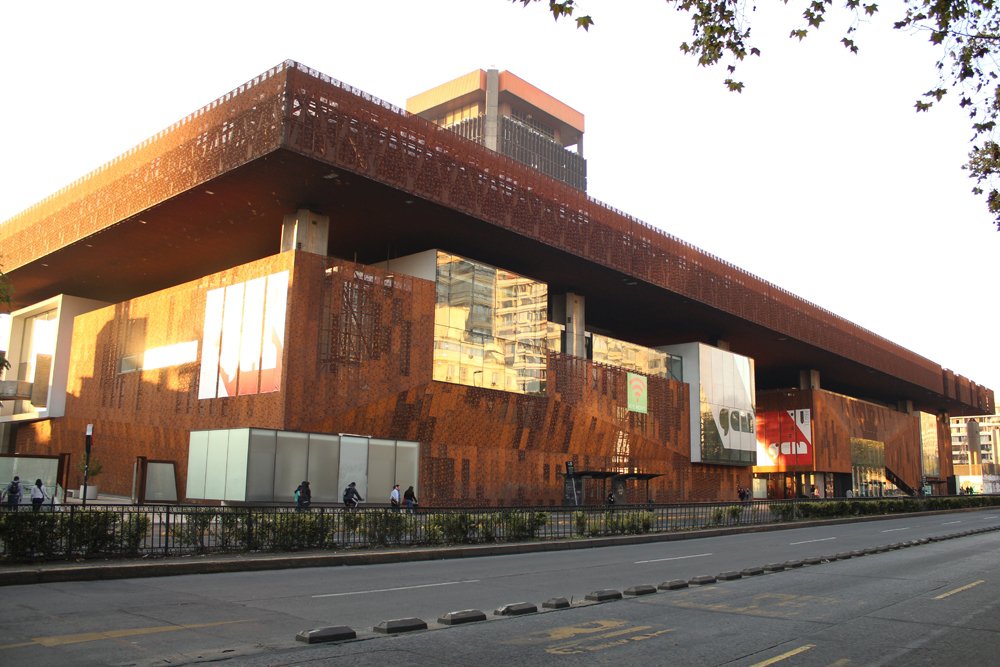
More than five million people (5,076,193) have visited the building of the Gabriela Mistral Center, GAM, since its opening on September 4, 2010, becoming one of the most visited cultural centers in Chile.
For the Executive Director of GAM, Alejandra Wood, this has meant collaborating on the cultural challenges posed by governments since 2010. One of them, reducing the gap in access to culture: "In the first months, the visiting public was a significant percentage of the ABC1 segment; that is, the usual pattern of cultural consumption in the country was reproduced. Today we see that our audiences have diversified and the visitors come from the C3, D and E have increased, along with a significant positioning in the C2 sector. This largely responds to the programming strategies and training of new audiences. In fact, 86% of those attending our audience development activities have done so for free."
Participating in the country's cultural policies, GAM has taken on other challenges, such as increasing the artistic offering with a total of 8,230 activities during the period that include theater, dance, music, exhibitions and cinema performances.
On the other hand, various instances of participation have been offered and opened that aim at the development of audiences and that have focused on schoolchildren in vulnerable situations, young people, older adults, teachers and people with disabilities.
"We have managed to convert the building into a meeting space between audiences and creators, with a varied offering that includes all artistic disciplines and that opens its public spaces for the demonstration of young people and visitors. And all in the heart of Santiago. Our management has focused on the development of consistent and permanent audience training policies, and today we can see the first fruits. In figures, we have carried out 5,643 activities of this type during 60 months. In addition, the presence has doubled of older adults,” adds Alejandra Wood.
Another challenge was communication. An attempt was made to expand the conversation on culture, explains Ximena Villanueva, director of communications and marketing. "We understand communications as a constant conversation, not as a unilateral delivery of information to try to attract an audience to GAM. We are not looking for viewers, but rather an active audience that comments on their interests and concerns. This involved social media strategies that led us to have an influence index that positions GAM as the leader in this ranking with 75 points on average compared to other Chilean cultural accounts," he comments.
In parallel, GAM has established value networks - a trend in vogue in culture - by generating alliances and links with Chilean and foreign communities and institutions. "We have been establishing collaborative relationships with other spaces in Latin America, such as the Teatro Solís in Montevideo and the Gran Teatro Nacional in Lima; the Audience Training program in Buenos Aires; the initiatives of the British Council; the programs of the Asimetrica agency in Madrid and Alternativa Teatral in Buenos Aires," explains Javier Ibacache, director of Programming at GAM. "At the national level, we have participated in the consolidation of the Theater Network; exchanges with the Teatro del Lago de Frutillar, the Municipal Theater of Temuco, and the Regional Theater of Maule - in addition to the articulation of networks of cultural centers."
New challenges are approaching with the second stage of GAM. The new building is currently under construction, on the land adjacent to the current surface, which will expand the infrastructure by an additional 16 thousand m2 and the cultural offer with a large room for approximately 2 thousand people. It will be a great challenge, comments José Miguel Herencia, director of administration and finance, but in these 5 years progress has been made. "In 2011, the contributions given to us by the National Council of Arts and Culture corresponded to 76% of our budget and the remaining 24% were our own income. In 2014, the contribution from the CCNA corresponded to 63% and we generated 37% of a total of $3,164,000," he comments.
Milestones
The historical, political and symbolic character of the GAM building is undoubted. In two decades it was the headquarters of an international conference, a meeting place for the community, a command center of the military dictatorship, a convention center in democracy, until it was completely destroyed in the fire of 2006. In September 2010, the new and remodeled building was built that took the name of Gabriela Mistral, current GAM, and was one of the main milestones of the Bicentennial celebrations. Today a multitude of young people dance in front of its windows, families walk with their children, older adults take dance and reading classes and new communities are formed every day.
Plays that have captured the attention of the public and critics, dance shows that have caused people to talk about their quality and transgression, emblematic exhibitions with record attendance figures and massive and free events in squares, are common activities in GAM that have contributed to the cultural capital of the country.
Some of the most relevant GAM productions and co-productions:
Theater: Amores de Cantina (2011), Hamlet (2012), Víctor sin Víctor Jara (2013), The Recording (2013), Coronación (2013), Allende, September Night (2013), A Streetcar Named Desire (2014), Prometheus the Origin (2014), Santiago High Tech (2014), The Mariner (2015) and The Tempest (2015)
Dance: Loop (2011), The Fixed Idea (2013), The Obstinate Night (2014), The Dancer (2015)
Visual arts: Indelible images of Koen Wessing (2011), Parra 100 (2014), Tuku Iho (2015) and Chile desde interior (2015)
Music: Gloria, opera (2013), The Rape of Lucrecia (2013), Classical music groups (since 2011), Neutral Festival (since 2012)
International: Off Buenos Aires Cycle (since 2011), Rising Sun of Japan in GAM (2013) and Epicenter of Dance Cycle (2015)
Massive free activities: Open classes Power Peralta (since 2012), Expo Yoga (since 2013) and ART STGO (since 2014), among others.