


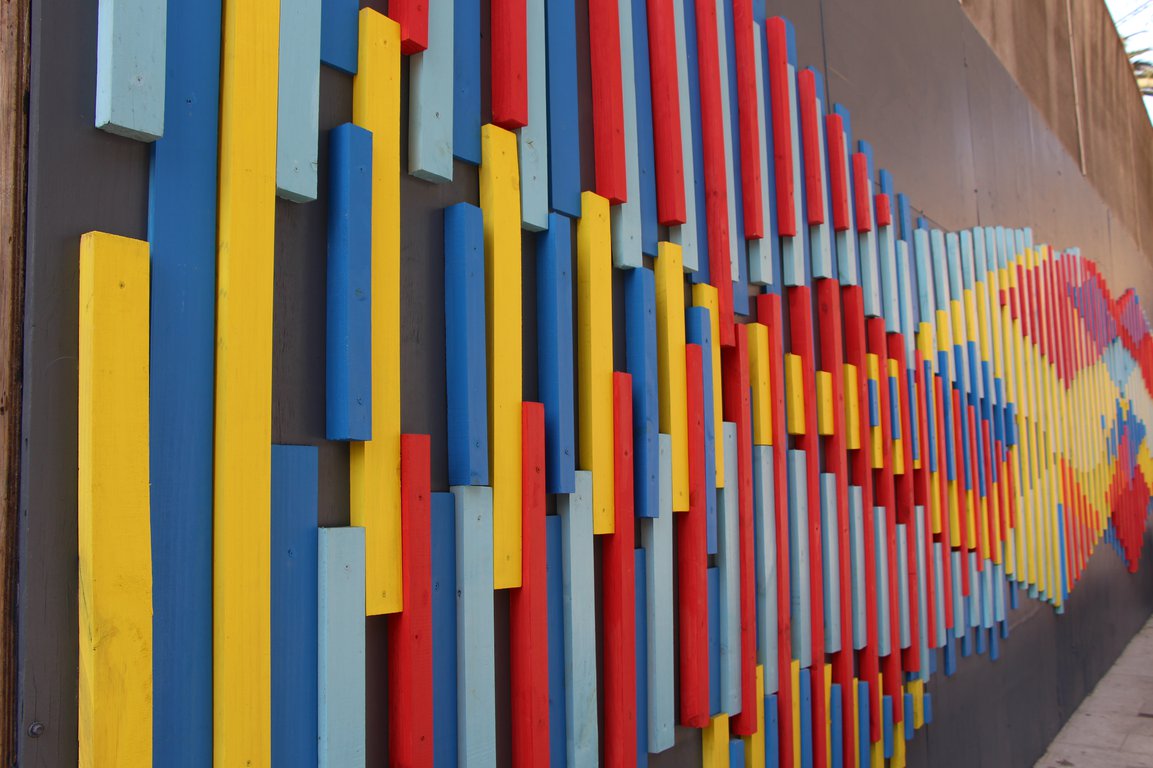
The artists Andrés García Figueroa and Sol Guillón were in charge of intervening in the five sections that the Architecture Directorate of the Ministry of Public Works made available in GAM. Both muralists opted for new technological proposals for the making of their creations, using full-scale prints and computational design.
The purpose of both interventions in public space is to bring art to the city, according to their authors in different interviews on the website aboutsantiago.cl.
A participatory mural
Reflecting the vast majority of Chileans, through popular art and Andean cosmogony, was the objective that Andrés García wanted to depict in his mural. He also addressed the concept of extinction in a social way and planted small texts along the extensive wall in order to leave passersby thinking. “My painting, in truth everything I do, has to do with discovering, being faced with chaos, but within the chaos there is an order,” concludes the artist.
Incorporating technology allowed him to provide a guide to pedestrians who wanted to help paint. Printing the paper at full size became a faster solution for making the mural, since other methods were impossible to carry out. Then people collaborated with the latex base, according to the colored dots printed on each segment.
In addition to the community, the muralist had the support of graffiti experts. "A group of graffiti artists from Peñalolén, Ohana, also helped me. They had the freedom to graffiti, mine was flat, I had defined the colors, but they contributed a lot, everything that is graffitied is theirs, the shadows, the colors, everything that is there in between."
The musicality of Gabriela Mistral
Sol Guillón's work is characterized by being built with a high component of kinetic art. His proposal is an allusion to the visual representation of Gabriela Mistral's sound and poem “Carro del cielo”. The artist divided the poem into two, relating different verses with cold and warm colors, creating a quartet of colors and a triplet of reliefs on a gray base.
"I have always found that poetry and music have things in common, because of the rhythms, the stanzas, the sensations that they produce in you. And I feel that all the arts are combined, so it was about uniting the three things. There I put everything in a cauldron: poetry, music, the visual arts; I stirred it and this came out", expressed Sol Guillón.
The construction of the mural was carried out through a computer model and then adapted to the available space. Furthermore, Guillón realized that the UNCTAD III building was in permanent dialogue with his work, due to the effects of the lighting and the atmosphere of the young people who gather to dance around it.
"When you are working there you discover things, like the sun when it passes through these little holes and makes the mural vibrate, in addition to the effects of color, reliefs and position. Something also happens with the shadow above, plus each stick projects its own shadow. Then the mural dances with the young people who are in the GAM."