


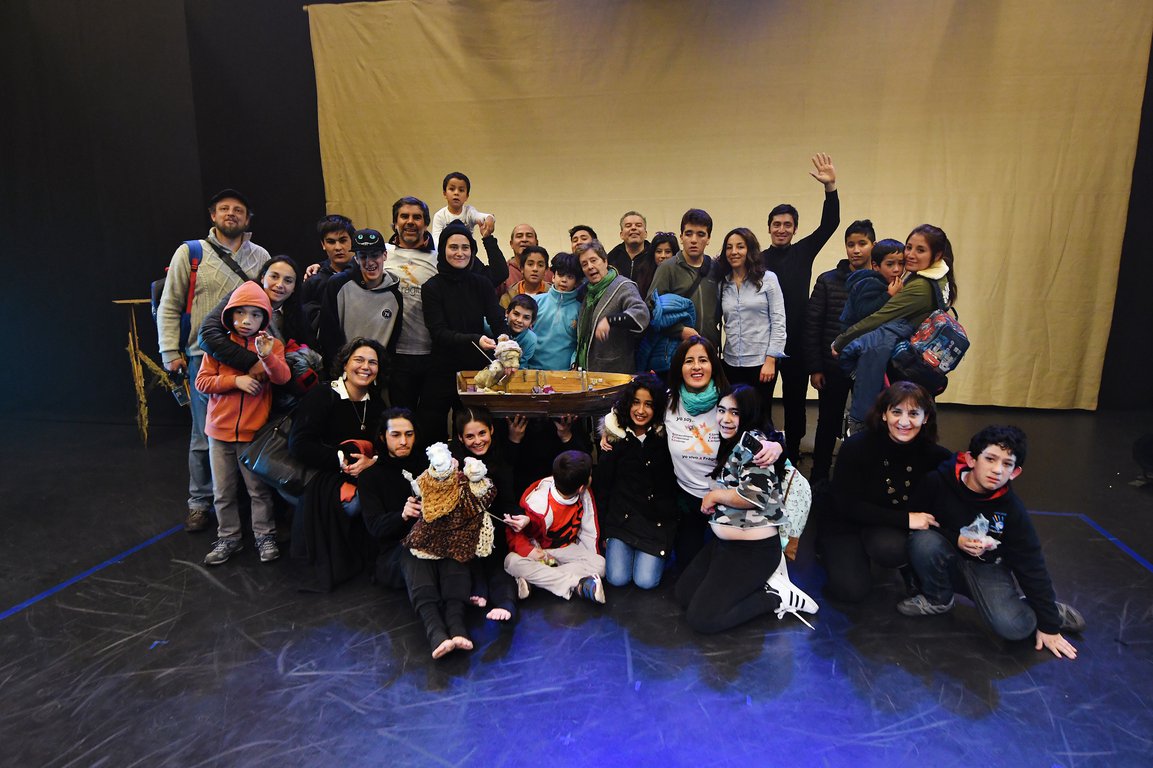
A new idea in our country, but not in the world. Relaxed functions have been implemented for at least 10 years in Great Britain and for 3 in Argentina. Chile, meanwhile, joins this list through the pilot project developed this year by the GAM Cultural Center, the X-Frágil Corporation, and the theater companies Silencio Blanco and Manada.
But what does this initiative consist of? Pamela López, director of programming and audiences at GAM, explains that these are functions designed for people with different sensory abilities: "small technical changes are generated in the work. For example, the lighting or music are modified to provide an environment protected from large noises or lighting changes that may affect a certain type of audience."
In addition, before each show, support material is provided so that people know, for example, the access to the hall or the location of the resting places specially set up for the performance. The idea, adds Pamela López, “is to eliminate the surprise factor and prepare well to welcome the dance or theater show.”
Democratize access to culture
A relaxed function is designed for people of all ages, especially for those who suffer from autism spectrum disorders, learning disorders, psychomotor disorders or who have hypersensitivity to noise, light and/or special communication needs. The idea, its organizers emphasize, is to include those audiences who, otherwise, would not be able to enjoy the performing arts.
One of these audiences is the Fragile X Corporation, a Chilean group that since 2016 has been working to improve the lives of people with Fragile X syndrome. Tania Salazar, communications coordinator and project manager, says that in addition to attending the relaxed functions, the corporation was in charge of developing 4 days to raise awareness among both the GAM team and the companies.
Regarding the project, Tania highlights the importance of ensuring that this type of initiative stops being seen as a favor, and manages to establish itself as one of the missions of institutions like the GAM: "This space that is opened goes far beyond the work. It is a space that contributes to the autonomy of the children, and finally of all those families who want their child to be able to fend for themselves later. Because always behind a person with a disability there is a family group that often has to stop enjoying the culture because they They close the door on your nose.”
The companies
Without a doubt this initiative also implies a great commitment on the part of the companies, which must not only modify their show depending on the audience, but also be open to other types of dynamics within the room, and accept, for example, that people have the freedom to enter or leave the performance whenever they wish.
"The families of the Corporación "We saw the need to put aside the creative ego and accept that our work may have modifications to give access to other people. That awareness of the other also has to come from the artists, we have to be willing to give in and open ourselves to new audiences," he adds.
Along the same lines, Dominga Gutiérrez, general producer of Pescador – another of the productions that this year was part of the relaxed functions of the GAM – highlights that although their work as a company Silencio Blanco had been aiming for inclusion for some time, the experience with “It is what the public needs.”
Dominga also emphasizes the importance of establishing a cultural policy on this issue in the future, "we must define who is in charge of this: the artists? the venues? the government? It is very important to emphasize that it is a white march in which we artists also make an important subsidy."
Along these same lines, Tania Salazar emphasizes the need for this to reach audiences of all ages, "because young people and adults with disabilities today do not have cultural or entertainment spaces. There is talk of inclusion in the school and work context, but there are few places where they can have fun, recreate or enjoy the performing arts."
For its part, GAM hopes in the future to generate a work system to have relaxed functions on a regular basis. Although during 2018 the call to participate was more limited, for 2019, says Pamela López, they are already incorporated into the GAM's annual call. "We must think that access to culture for people with disabilities is a right, and that right implies that cultural spaces have the opportunity to provide that offer. Not as something that happens once a year, but as something that should occur in a stable and permanent way over time."
Photo credits: Jorge Sánchez-GAM
Contact X-Frágil Corporation: contacto@xfragil.cl
Text: Teatro a Mil Foundation