


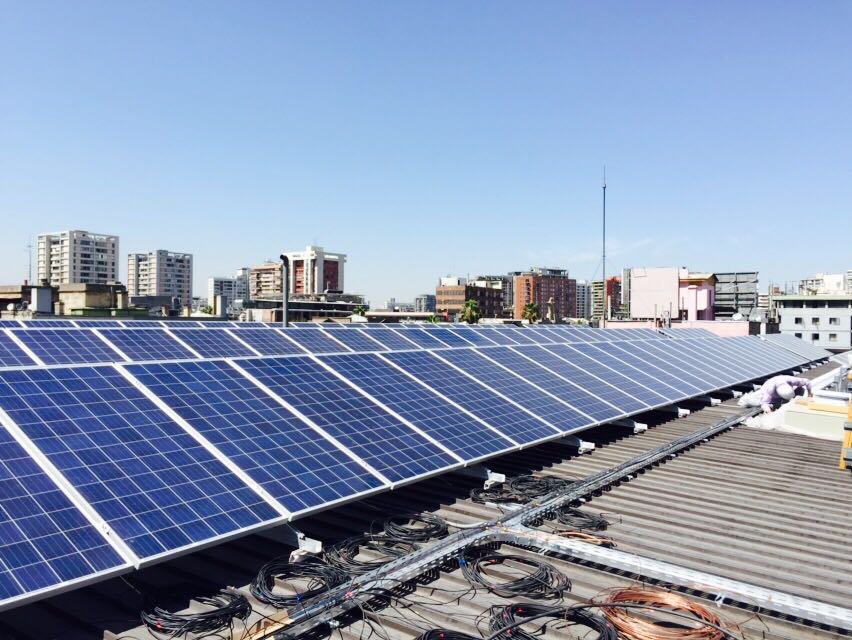
This Thursday, the largest solar energy plant built on public roofs was inaugurated at the Gabriela Mistral Cultural Center, which will produce energy equivalent to that consumed by 70 homes.
This project, with 100 kilowatts of installed capacity and developed through the Public Solar Roofs Program of the Ministry of Energy, will generate enough electrical energy to supply 70 houses, 1,500 public lights, 82 performing or musical arts functions or 75 audience training activities per year.
“This will allow the GAM to use said energy for its cultural purposes, but also, it will allow it to inject energy that is not consumed, and thus allocate resources to other aspects that are relevant. With this type of initiatives, we are helping Chile have cleaner and cheaper energy," said the Minister of Energy, Máximo Pacheco.
On the occasion, a conversation panel called "GAM: From Social Architecture to Sustainable Urban Planning" was also held, where the Minister of Culture, Ernesto Ottone, participated; the director of the GAM, Felipe Mella; and the national architect and promoter of the building within the framework of UNCTAD, Miguel Lawner.
The panelists highlighted the leap in technology and the importance that comes with advancing in sustainable energy, both in homes and in public buildings.
"The cultural sector is very excited with this first instance of GAM having been selected in the public solar roof project. For us it is very important since we have more than 10 rooms (theater, dance, exhibitions) that today consume a high percentage of lighting. Today, with this large contribution of 200 m2 of solar roofs in our building, we will be able to save 10% of the energy and thus allocate it to artistic programming," said Felipe Mella, executive director of the GAM Center.
“It is great news, since this building was born marked by innovation. Having incorporated solar panels means adding new and fruitful years of life to the Centro Corporation building. Cultural GAM”, stated Miguel Lawner.
For his part, the Minister of Culture, Ernesto Ottone, pointed out that, without a doubt, maintenance costs are one of the largest expenses that buildings of these characteristics must incur. “Being able to assimilate certain more innovative measures in energy saving, but also be participants in the injection, is one of the purposes of any cultural center, which are public spaces at the service of citizens.”
In this sense, with the installation of solar panels, the GAM Cultural Center Corporation will be saving approximately 8 million pesos per year between now and 2040 (with a 25-year useful life) equivalent to 10% of the city's consumption. building. Likewise, it will contribute to mitigating the effects of climate change, avoiding the emission of approximately 40 Tons of CO2.